
SpaceX Starship Historic Test: Booster Ends In Gulf Sea Landing After Abort, Spacecraft Eyes First-Ever Chopsticks Catch On Saturday
After launching on Friday evening, SpaceX's Starship Flight 15 Super Heavy booster diverted to a successful offshore landing after failing a safety check, forcing controllers to call off the planned tower catch.
- Science News
- 3 min read


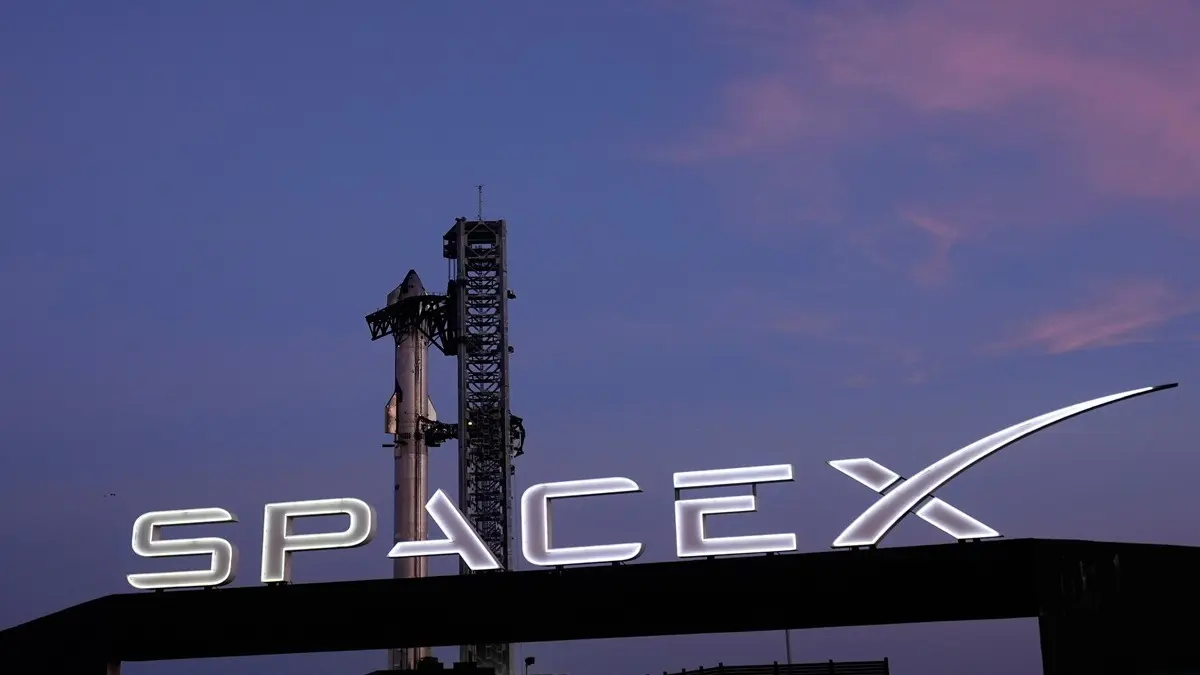
Florida: SpaceX on Friday sent Starship into orbit for the boldest test so far, which is a 22-hour flight to capture the entire rocket, meant to accelerate Moon and Mars travel. However, the first part of the double catch failed, as the booster was diverted offshore instead of returning to the Texas launch pad minutes after liftoff, and fell into the Gulf of Mexico and exploded.
Despite the incident, the bullet-shaped spacecraft continued toward orbit, with possible steering toward the pad on Saturday for a similar grab, barring further trouble.
Catching The Ship From Orbit
It is the first time the spacecraft will try to return to the pad from orbit, to be plucked in midair by mechanical arms on the launch tower. The goal was to retrieve every piece for future recycling, something to be achieved anywhere. SpaceX Chief Elon Musk sees this leading to the fast, consistent launch rates needed for moon bases and Mars missions.
Once in orbit, Starship will deliver 26 of the company's most advanced Starlink satellites and will complete 15 laps at around 275 km before heading back for Saturday's finale.
Advertisement
Giant Rocket, Bigger Test
SpaceX had already made 3 booster grabs at Starbase near the US-Mexico border, which was the first attempt to capture the upgraded version stretching 236 feet, the production model for Moon and Mars. It will also be the first attempt to catch the spacecraft, spanning 171 feet, forming together the world's biggest and most powerful rocket, 407 feet tall.
The spacecraft from the 14 previous Starships ended in the ocean, either by design or in flaming wreckage. During the first full-scale test in 2023, multiple engines failed to ignite, and the tumbling rocket's self-destruct system was activated. The last test, in September, was the first to reach orbit, but SpaceX did not try to recover any stages.
Advertisement
Why Full Reusability Matters
SpaceX planned to launch Starships from Florida within a few months and from Louisiana in a few years. Scaled-up infrastructure, combined with full reusability, is “how you go from zero launches to 10 to 100 to 1,000 to 10,000 to 100,000,” SpaceX's Kiko Dontchev, Vice President of launch, stated at a NASA tech summit last week at Florida's Kennedy Space Center.
Falcon rockets will continue to fly from Cape Canaveral, carrying astronauts to the International Space Station (ISS) for NASA and from California carrying Starlink satellites. The satellites will keep hitching Falcon rides for now as Musk wants Starships to eventually replace Falcons.
“Falcon rockets are still not fully reusable. We still throw that second stage away every single flight. Starship, we're going to catch both the first stage and second stage,” Dontchev said.
Moon Race Behind It
NASA is paying SpaceX billions to land Artemis astronauts on the Moon with Starships, as Jeff Bezos' Blue Origin emerged as the other major player. NASA is expected to decide a year before the Artemis IV lunar landing, the first by astronauts in over half a century, whether to get moonwalkers down with Musk's Starship or Bezos' Blue Moon.
During next summer's Artemis III mission, astronauts will practise docking their capsule with a Blue Moon and then a Starship in orbit around Earth. The successful completion of the docking process will set the stage for an Artemis Moon touchdown as early as 2028.